Palaeo Portfolio

New illustrations every week

Tuesday, August 01, 2006

Southwestern dragon


© 2006 Kyle R. Lindsey

A rough sketch of the
Acrocanthosaurus atokensis specimen NCSM 14345 as displayed in the Black Hills Museum of Natural History. Lighter than but as long as the Tyrannosaurus rex specimens BHI 3033 and MOR 555 at 41 feet, this specimen puts A. atokensis as one of the largest of predatory dinosaurs to be collected. The femur length is roughly 1280 mm, which is a bit shy to the femur length of the Tyrannosaurus PR2081 --otherwise known as SUE-- at just over 1300 mm.

The specimen of
A. atokensis was recovered from the Antlers formation of McCurtain County, Oklahoma. The Antlers formation is known from the Trinity Group and dated as Aptian* in age. Possible fragments of the same species are known from the Ruby Ranch member of the Cedar Mountain formation, which happens to be of the same age as the Antlers. The A. atokensis is also known from north central Texas and thought to be responsible for the larger theropod tracks in Glen Rose.

Taxonomy:

Theropoda Marsh, 1881
Carnosauria von Huene, 1920
Allosauroidea Currie and Zhao, 1993
Allosauridae Marsh, 1878

A more complete and revised version of this sketch (now what is seen) will be included in a later illustration displaying a panoply of various palaeopathologic injuries in dinosaurs, both predator and prey species. The later work will be fittingly entitled "Red in tooth and claw."

*Aptian is
a sub-division of the early Cretaceous period that spans from 121 to 112.2 million years before the present Holocene.

Sunday, July 30, 2006

Tyrannosaurus study

For starters, I thought you all might enjoy the recent sketches I have been working on concerning two of the best specimens of Tyrannosaurus rex ever. Period. They are BHI 3033 and PR2081. Both are known better by their nicknames: STAN & SUE. Both specimens were excavated by the Black Hills Institute of Geological Research in western South Dakota in the early nineties.

STAN was found near Buffalo in Harding County and SUE was found near Faith in
Ziebach county. STAN is well preserved in the skull, cervical vertebrate and the pelvic and leg region. SUE is the most complete tyrannosaur known to date, though bones belonging to STAN are still being excavated and could replace SUE as the most complete Tyrannosaurus rex skeleton in collection. The skull and skeleton of STAN has already been become the STANdard in tyrannosaur studies.

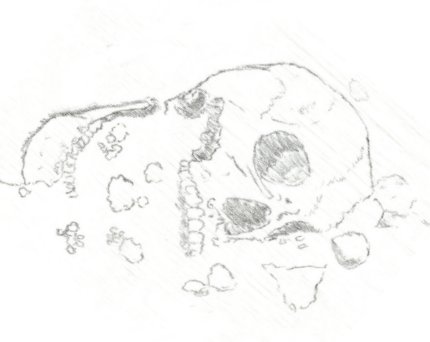
The illustrations below are as follows: SUE's skull in situ; the lower pelvic elements and legs of STAN and the right foot of STAN. The skull of SUE was draw roughly about three weeks ago while I was looking at an older photograph of her skull at the BHIGR. The legs were drawn soon after that based on another picture of a STAN mount. The foot sketch is the oldest. It was drawn rather speedily during the tyrannosaur symposium last year in Hill City, South Dakota.

© 2006 Kyle R. Lindsey

The skull of the Tyrannosaurus rex specimen FMNH PR2081, more commonly known as 'Sue.' The cranial material is drawn in the position that it originally laid in during its preparation by Terry Wentz. The muzzle is compressed ventrally immediately following the orbits due to geologic pressures. The massive block of siltstone to the right contains pelvic elements.

My favorite feature of this skull is the paleopathology found on the right side of the skull. Notice the abnormal swelling in the postorbital, excess bone growth that fills in the bottom half of the orbital, apparent case of exostosis of the jugal and the small lump on the ventral side of the angular. The Field museum's traveling exhibit for SUE says that there aren't any bite pathologies found on the skull but I say that is complete stierscheiße and they know it.

The hypothesis that tyrannosaurs were obligate scavengers because they are supposedly slow is completely arrogant of the osteological evidence. While tyrannosaurs may seem slow to us in a world filled with jet planes and Ferraris, it was certainly one of the fastest terrestrial animals for its size. Tyrannosaurids are characterized by long tibiae and metatarsi that bare a striking similiarity to the ostrich-like ornithomimosaurids.
And like ornithomimosaurids, tyrannosaurids also have what is called an arctometatarsus. An arctometatarsus is where metatarsal III forms a wedge distally, but pinches out proximally. This feature is unique and found in some ornithomimosaurs, deinonychosaurs, alvareszaurids, and oviraptorosaurs. An arctometatarsus has also been shown to be a good and natural shock absorber for fast running.

My Palaeo Portfolio

The concept is simple. Palaeos Bios publishes news articles, events and my ramblings of the palaeontology world. PalaeoPortfolio publishes merely my day-to-day illustrations and sketches of all things paleontology. Of course the most you will find here are skeletal drawings, since I'm no Robert Bakker or Greg Paul when it comes to putting flesh on the bones.

And yet I find that there is no copying or end to the possibilities of what you can draw with bones. You might notice after a while that I have a particular subject matter that I am most interested in when I illustrate. I am anxious to see the progress of this site as I hope others are. Until my next post...

Cheers.